Pressure testing...? Seriously, how can shutting the well in determine where any leaks are ?
Why blur the lines with changing definitions..? .pressure testing, integrity testing, same difference.
One of my main curiosities over the past 3 months was how produced sand would figure into this scenario.
Now we get reports of possible collapses downhole....duh.....didn't see that coming, how could you possibly think that over 3 months, that some sort of subsidence would not happen ?
Bore collapses when drilling original well, bore starts to slough after drilling was halted for storm evacuation...
....brittle shale over sand/sandstone........
...so here we sit, waiting to hear the next news ....I would put money on more delays and pressure testing.
Thursday, August 19, 2010
A virtual rainbow
Many time I have been watching the feeds of the ROV cams, only to see so many different lighting types, but also different colors, I'm sure you have too....
I have my theory about the different colors, I thinks it's basically caused by sonar. I'll explain with a few simple excerpts from Wikipedia.
Raman scattering or the Raman effect
In 1922, Indian physicist C. V. Raman published his work on the "Molecular Diffraction of Light," the first of a series of investigations with his collaborators which ultimately led to his discovery (on 28 February 1928) of the radiation effect which bears his name. The Raman effect was first reported by C. V. Raman and K. S. Krishnan, and independently by Grigory Landsberg and Leonid Mandelstam, in 1928. Raman received the Nobel Prize in 1930 for his work on the scattering of light.
When light is scattered from an atom or molecule, most photons are elastically scattered (Rayleigh scattering), such that the scattered photons have the same energy (frequency) and wavelength as the incident photons. However, a small fraction of the scattered light (approximately 1 in 10 million photons) is scattered by an excitation, with the scattered photons having a frequency different from, and usually lower than, the frequency of the incident photons. In a gas, Raman scattering can occur with a change in vibrational, rotational or electronic energy of a molecule . Chemists are concerned primarily with the vibrational Raman effect.
The Raman effect differs from the process of fluorescence. For the latter, the incident light is completely absorbed and the system is transferred to an excited state from which it can go to various lower states only after a certain resonance lifetime. The result of both processes is essentially the same: A photon with the frequency different from that of the incident photon is produced and the molecule is brought to a higher or lower energy level.
But the major difference is that the Raman effect can take place for any frequency of the incident light.
Here's some various minerals under the effect, beautiful...
http://en.wikipedia.org/wiki/Raman_scattering
So lets say that a certain wavelength of sonar was being used in front of an ROV,. The ROV is using the sonar, and at the same time, lighting the area and filming simultaneously. There are many things suspended in the water around the well, everything from heavy ppms of various minerals, to COREXIT ( there is an autonomous dispersant system in use on the seafloor, it's in the official BP press release documents. ) to dispersed oil, etc etc, I'll skip a long-winded list, I'm sure you get the idea. . So....sonar.....suspended particulates, ultrasonically attenuated light and fluorescing minerals and compounds....seems fairly simple to me.
http://en.wikipedia.org/wiki/Attenuation#Ultrasound
The frequency of light scattered from a molecule may be changed based on the structural characteristics of the molecular bonds. Attenuation of light is important in physical oceanography. Here, attenuation is the decrease in light intensity with depth due to absorption by water molecules and scattering by suspended particulates. This same effect is an important consideration in weather radar as rain drops absorb a part of the emitted beam that is more or less significant depending on the wavelength used.
......ultrasound can also effect transmission in fiber optic lines, which is what ROV's use to send all data to the surface., but I'm sure you read those Wikipedia pages, right ?
I have my theory about the different colors, I thinks it's basically caused by sonar. I'll explain with a few simple excerpts from Wikipedia.
Raman scattering or the Raman effect
In 1922, Indian physicist C. V. Raman published his work on the "Molecular Diffraction of Light," the first of a series of investigations with his collaborators which ultimately led to his discovery (on 28 February 1928) of the radiation effect which bears his name. The Raman effect was first reported by C. V. Raman and K. S. Krishnan, and independently by Grigory Landsberg and Leonid Mandelstam, in 1928. Raman received the Nobel Prize in 1930 for his work on the scattering of light.
When light is scattered from an atom or molecule, most photons are elastically scattered (Rayleigh scattering), such that the scattered photons have the same energy (frequency) and wavelength as the incident photons. However, a small fraction of the scattered light (approximately 1 in 10 million photons) is scattered by an excitation, with the scattered photons having a frequency different from, and usually lower than, the frequency of the incident photons. In a gas, Raman scattering can occur with a change in vibrational, rotational or electronic energy of a molecule . Chemists are concerned primarily with the vibrational Raman effect.
The Raman effect differs from the process of fluorescence. For the latter, the incident light is completely absorbed and the system is transferred to an excited state from which it can go to various lower states only after a certain resonance lifetime. The result of both processes is essentially the same: A photon with the frequency different from that of the incident photon is produced and the molecule is brought to a higher or lower energy level.
But the major difference is that the Raman effect can take place for any frequency of the incident light.
Here's some various minerals under the effect, beautiful...
http://en.wikipedia.org/wiki/Raman_scattering
So lets say that a certain wavelength of sonar was being used in front of an ROV,. The ROV is using the sonar, and at the same time, lighting the area and filming simultaneously. There are many things suspended in the water around the well, everything from heavy ppms of various minerals, to COREXIT ( there is an autonomous dispersant system in use on the seafloor, it's in the official BP press release documents. ) to dispersed oil, etc etc, I'll skip a long-winded list, I'm sure you get the idea. . So....sonar.....suspended particulates, ultrasonically attenuated light and fluorescing minerals and compounds....seems fairly simple to me.
http://en.wikipedia.org/wiki/Attenuation#Ultrasound
The frequency of light scattered from a molecule may be changed based on the structural characteristics of the molecular bonds. Attenuation of light is important in physical oceanography. Here, attenuation is the decrease in light intensity with depth due to absorption by water molecules and scattering by suspended particulates. This same effect is an important consideration in weather radar as rain drops absorb a part of the emitted beam that is more or less significant depending on the wavelength used.
......ultrasound can also effect transmission in fiber optic lines, which is what ROV's use to send all data to the surface., but I'm sure you read those Wikipedia pages, right ?
Removing the BOP stack..?
Hhhmm.........ok.....I'd like to know how this is going to be accomplished.
After Deepwater Horizon sinking, with the riser still attached.....I have my doubts that the shallow cement shoes are sturdy , I have a real hard time believing that there is oil & gas not leaking up the annulus, from the reservoir or higher areas around the wellbore ( They are called" lenticulars " or lenses of sand and are found laterally to the side of the bore in surrounding formations of shale ) and finding un-seated joints in the wellbore and migrating laterally out through the mudline, I have an even harder time believing that there was no damage to the outer layer of cement lining the wellbore when DWH sank.
We all know that they had to use cables and winches to straighten out the flex joint on top of the BOP stack, before they added the 3-ram capping stack.
Why...?
Because it was bent,..... and if it was bent, than that means that the force applied when the sinking platform torqued not just the flex-joint , but the other parts of the system below it, all of which are joined with technical precision in a series of hubs, locks and seals which allow various parts of the system to fit together, and fit together well enough to contain high volume flows of crude oil and gas.
Looking at the following diagram, I still have my doubts these connections are 100% structurally integral.
....here is a rare picture....the base of the BOP at the ocean floor...look undamaged to you...?
............ So how do you remove the BOP stack and attach a new one to a damaged connection ?
.......then there's that ugly fact they cemented (read "trapped" ) fluid into a supposedly sealed space, ie" the annulus ", so there's a fluid of unknown compressability in a space whose integrity is unknown also....great.
.....for weeks now, I have wondered where this trapped fluid was supposed to go...?
. ....if the cement at the bottom was completely blocking flow ( communication ) with the reservoir and thereby blocking any fluids from coming up the annulus, why are they looking for seeps ?
...and... BTW, try to find any info on high volume/large biogenic seeps like Ken Wells says was the source of the gas around the wellhead....you won't find biogenic methane being produced in large enough quantities to vent from the seafloor,....it gets frozen into hydrates long before it leaks out of the mud and rock.
..Then it can get warmed and will dissociate in large enough amounts to be noticeable as a seep, if fluids erode their way into the area they have formed in.
......if what Mr.Wells were saying was true, those particular " miracle " microbes would be put to use already in the petroleum industry making natural gas....
....Only thermogenic gas can migrate fast enough to establish pathways in the strata, only thermogenic is produced in those high quantities. Yes, there are biological traces of microbial gas ( methogenic, biogenic ) in most thermogenic gas, but are they are a small fraction considering the main source they are found with.
...if the wellbore isn't damaged, the annulus shouldn't be leaking into the surrounding geology and finding it's way up though the mud.
...if it is damaged....how do you guarantee that any fluids/cement you pump into it won't just get pushed right up and out... ?
......if the cement job is allowing fluids to leak up the annulus from the reservoir, then how will it provide enough resistance for the incoming mud to push the heavier fluid up through the annulus, instead of blowing the plug out backwards into the reservoir ?
......at least this sudden conundrum should quell myths about " switched-out wellheads" and blowout preventers secretly already replaced in secretive underwater operations.
......But,... enough with off-the-cuff engineering, seriously,.. what's next ...?..the flux capacitor and the inverted-vortex 9 ram gate-valve-piston shear capping-riser ?
....Can I get a shake & some fries with that ?
..
After Deepwater Horizon sinking, with the riser still attached.....I have my doubts that the shallow cement shoes are sturdy , I have a real hard time believing that there is oil & gas not leaking up the annulus, from the reservoir or higher areas around the wellbore ( They are called" lenticulars " or lenses of sand and are found laterally to the side of the bore in surrounding formations of shale ) and finding un-seated joints in the wellbore and migrating laterally out through the mudline, I have an even harder time believing that there was no damage to the outer layer of cement lining the wellbore when DWH sank.
We all know that they had to use cables and winches to straighten out the flex joint on top of the BOP stack, before they added the 3-ram capping stack.
Why...?
Because it was bent,..... and if it was bent, than that means that the force applied when the sinking platform torqued not just the flex-joint , but the other parts of the system below it, all of which are joined with technical precision in a series of hubs, locks and seals which allow various parts of the system to fit together, and fit together well enough to contain high volume flows of crude oil and gas.
Looking at the following diagram, I still have my doubts these connections are 100% structurally integral.
....here is a rare picture....the base of the BOP at the ocean floor...look undamaged to you...?
............ So how do you remove the BOP stack and attach a new one to a damaged connection ?
.......then there's that ugly fact they cemented (read "trapped" ) fluid into a supposedly sealed space, ie" the annulus ", so there's a fluid of unknown compressability in a space whose integrity is unknown also....great.
.....for weeks now, I have wondered where this trapped fluid was supposed to go...?
. ....if the cement at the bottom was completely blocking flow ( communication ) with the reservoir and thereby blocking any fluids from coming up the annulus, why are they looking for seeps ?
...and... BTW, try to find any info on high volume/large biogenic seeps like Ken Wells says was the source of the gas around the wellhead....you won't find biogenic methane being produced in large enough quantities to vent from the seafloor,....it gets frozen into hydrates long before it leaks out of the mud and rock.
..Then it can get warmed and will dissociate in large enough amounts to be noticeable as a seep, if fluids erode their way into the area they have formed in.
......if what Mr.Wells were saying was true, those particular " miracle " microbes would be put to use already in the petroleum industry making natural gas....
....Only thermogenic gas can migrate fast enough to establish pathways in the strata, only thermogenic is produced in those high quantities. Yes, there are biological traces of microbial gas ( methogenic, biogenic ) in most thermogenic gas, but are they are a small fraction considering the main source they are found with.
...if the wellbore isn't damaged, the annulus shouldn't be leaking into the surrounding geology and finding it's way up though the mud.
...if it is damaged....how do you guarantee that any fluids/cement you pump into it won't just get pushed right up and out... ?
......if the cement job is allowing fluids to leak up the annulus from the reservoir, then how will it provide enough resistance for the incoming mud to push the heavier fluid up through the annulus, instead of blowing the plug out backwards into the reservoir ?
......at least this sudden conundrum should quell myths about " switched-out wellheads" and blowout preventers secretly already replaced in secretive underwater operations.
......But,... enough with off-the-cuff engineering, seriously,.. what's next ...?..the flux capacitor and the inverted-vortex 9 ram gate-valve-piston shear capping-riser ?
....Can I get a shake & some fries with that ?
..
Wednesday, August 18, 2010
Sniff testing...?
I can tell you that from my training as a chef, that sniff testing is complete and utter bullshit.
Any chef or cook knows that seafood, especially processed seafood, can smell...questionable.....at any given time. Unfortunately the majority of seafood sold to restaurants has been treated, frozen, sometimes thawed and frozen by accident several times.
As a few examples:
Ahi Tuna steaks served by most restaurants....nice and pink..
.....It's gassed on the boat at sea with carbon monoxide to keep the flesh from oxidizing and turning brown, then flash-frozen. Yum.
Scallops, nice and juicy tender ...
....wet-packed with tri-sodium phosphate for moisture retention ( read=adding weight to the product in the form of water )
Black Tiger shrimps from Thailand, sweet and meaty
...Thai fishermen are fond of pouring a little bit of diesel fuel into their catch holds to prevent seafood from rotting when there is no refrigeration available on the vessel, common.
........So the truth of the matter is that if you are used to cooking with things that already have a "funny smell", then sniff testing is pointless.
Now, let's ask some crucial questions :
Has the testing taken into account that there are various types of fish ?
Has the testing examined the various parts of the fish ?
How has testing declared seafood safe to eat, when there are no previous studies to go by ?
Why is only "sniff-testing" being suggested ?
Has NALCO been asked for the proprietary information about COREXIT's constituents ?
Fatty fish don't get around too much, lean fish are travelers. It's like the difference between farm-raised salmon and wild-caught salmon. Farm raised salmon are much fattier, they don't have too many chances to get exercise, hence the fat.
There has been no testing of various parts of the fish....when I get a whole fish, I break it down, and usually make a nice fumet out of the body and head ( stock )...although not always the heads, depends on the fish I am using.
Large processing operations and small processors alike, sell their scraps. If you are on the coast, most likely, you can get fish bodies for stock from your local purveyor.
Larger plants will sell their scraps for pet food, fertilizer, and ........cooking into commercial soup bases, which many restaurant sadly use these days to make soups, stews and sauces.
Pollutants tend to bio-accumulate in different areas of an organism, fatty tissues are a favorite location, but organs like the liver are prime targets too.
Until I see some shrimp, scallops, and whole fish, split head to tail and examined under UV light for presence of hydrocarbons, I will be suspicious. ...and I'm sure, given modern technology, that we can come up with a better testing method....
..... like I tell people, " if you don't mind, than it doesn't matter ".
Any chef or cook knows that seafood, especially processed seafood, can smell...questionable.....at any given time. Unfortunately the majority of seafood sold to restaurants has been treated, frozen, sometimes thawed and frozen by accident several times.
As a few examples:
Ahi Tuna steaks served by most restaurants....nice and pink..
.....It's gassed on the boat at sea with carbon monoxide to keep the flesh from oxidizing and turning brown, then flash-frozen. Yum.
Scallops, nice and juicy tender ...
....wet-packed with tri-sodium phosphate for moisture retention ( read=adding weight to the product in the form of water )
Black Tiger shrimps from Thailand, sweet and meaty
...Thai fishermen are fond of pouring a little bit of diesel fuel into their catch holds to prevent seafood from rotting when there is no refrigeration available on the vessel, common.
........So the truth of the matter is that if you are used to cooking with things that already have a "funny smell", then sniff testing is pointless.
Now, let's ask some crucial questions :
Has the testing taken into account that there are various types of fish ?
Has the testing examined the various parts of the fish ?
How has testing declared seafood safe to eat, when there are no previous studies to go by ?
Why is only "sniff-testing" being suggested ?
Has NALCO been asked for the proprietary information about COREXIT's constituents ?
Fatty fish don't get around too much, lean fish are travelers. It's like the difference between farm-raised salmon and wild-caught salmon. Farm raised salmon are much fattier, they don't have too many chances to get exercise, hence the fat.
There has been no testing of various parts of the fish....when I get a whole fish, I break it down, and usually make a nice fumet out of the body and head ( stock )...although not always the heads, depends on the fish I am using.
Large processing operations and small processors alike, sell their scraps. If you are on the coast, most likely, you can get fish bodies for stock from your local purveyor.
Larger plants will sell their scraps for pet food, fertilizer, and ........cooking into commercial soup bases, which many restaurant sadly use these days to make soups, stews and sauces.
Pollutants tend to bio-accumulate in different areas of an organism, fatty tissues are a favorite location, but organs like the liver are prime targets too.
Until I see some shrimp, scallops, and whole fish, split head to tail and examined under UV light for presence of hydrocarbons, I will be suspicious. ...and I'm sure, given modern technology, that we can come up with a better testing method....
..... like I tell people, " if you don't mind, than it doesn't matter ".
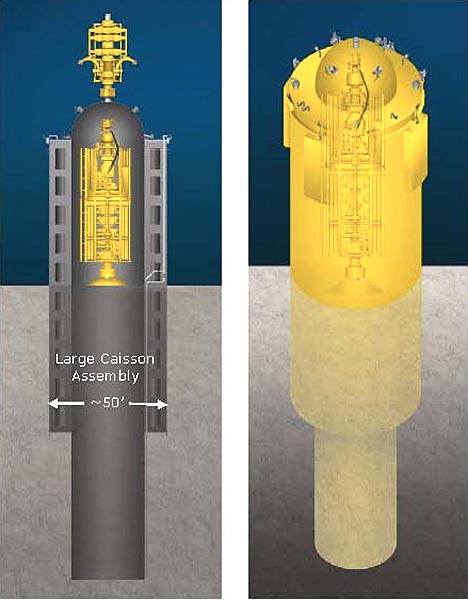
New system in development..seems familiar in concept to something...oh yeah, I remember..
........My idea for containing the wellhead.
...Although different in design, exactly the same in concept.....large heavy box with the ability to capture oil.
You can bet I will keep track of this "new" developing technology, just out of curiosity of course.
The following is from the Oil Drum
" If the integrity of the end of the well is compromised (i.e. the rock fragmented, the liners broken or the wellhead destroyed in some way), then a different approach will be required.
Here a caisson assembly will be constructed around the remnant BOP, large enough to surround the well at a point where the rock has enough strength and quality to allow a seal under the wall. This will then allow a cap to be placed on top of the caisson, with the containment system from the last slide, mounted on top of the cap, as a way of capturing the hydrocarbons that are bled off from the well, without their coming into contact with the seawater, and forming hydrates. "

(ExxonMobil )
----------------------------------------------------------------------------
Lol, Isaac wants royalties....or some help getting student loans to study engineering...hint hint
...Although different in design, exactly the same in concept.....large heavy box with the ability to capture oil.
You can bet I will keep track of this "new" developing technology, just out of curiosity of course.
The following is from the Oil Drum
" If the integrity of the end of the well is compromised (i.e. the rock fragmented, the liners broken or the wellhead destroyed in some way), then a different approach will be required.
Here a caisson assembly will be constructed around the remnant BOP, large enough to surround the well at a point where the rock has enough strength and quality to allow a seal under the wall. This will then allow a cap to be placed on top of the caisson, with the containment system from the last slide, mounted on top of the cap, as a way of capturing the hydrocarbons that are bled off from the well, without their coming into contact with the seawater, and forming hydrates. "
----------------------------------------------------------------------------
Lol, Isaac wants royalties....or some help getting student loans to study engineering...hint hint
Subscribe to:
Posts (Atom)